
Workplace Darwinism: Deferred Recognition of Poor Decision-Making
Working Paper Status
Division: Behavioral Observation Unit
Classification: Workplace Risk Review
Primary concern: Why obviously unstable work decisions often appear reasonable until viewed later, or from a safer distance.
WP-005 documents a narrower but highly repeatable behavior class: work performed under visible instability by subjects who appear, at least temporarily, satisfied with the arrangement. The key variable is not ignorance. It is deferred recognition.
Abstract
This paper reviews a limited set of workplace images showing improvised elevation, electrical proximity, unstable load support, suspended exterior task execution, and non-specialized mechanical substitution. In each case, the task appears to have been treated as achievable despite immediately visible failure points. The paper proposes that the question “What was I thinking?” often emerges only after the conditions requiring thought have already passed.
Primary finding.
“At the time, the action appears workable. Later, the same action becomes difficult to defend.”
Statement of the Question
Why do otherwise recognizable hazards become temporarily acceptable when attached to a task that someone wants finished?
Crow University proposes that the answer is not pure recklessness, but a recurring shift in judgment under pressure. Completion begins to outrank stability. Access begins to outrank method. Familiarity begins to substitute for safety. The result is not always immediate catastrophe. It is often something more durable: photographic evidence that later defeats its own defense.
Working premise. Poor workplace decisions are frequently situationally rational and structurally unsound.
Conditions of Failure
Improvised support systems are treated as temporary enough to seem acceptable and stable enough to avoid reconsideration.
Hazard proximity is normalized when the subject believes the task is brief, familiar, or already underway.
Completion pressure narrows attention until the work itself remains visible and the failure path does not.
Filed observation. The subject is rarely trying to fail. The subject is trying to finish.
Exhibit 01. Improvised Elevation System
The subject constructs a vertical access solution using stacked, non-fixed surfaces. Elevation is achieved. Reliability is not.
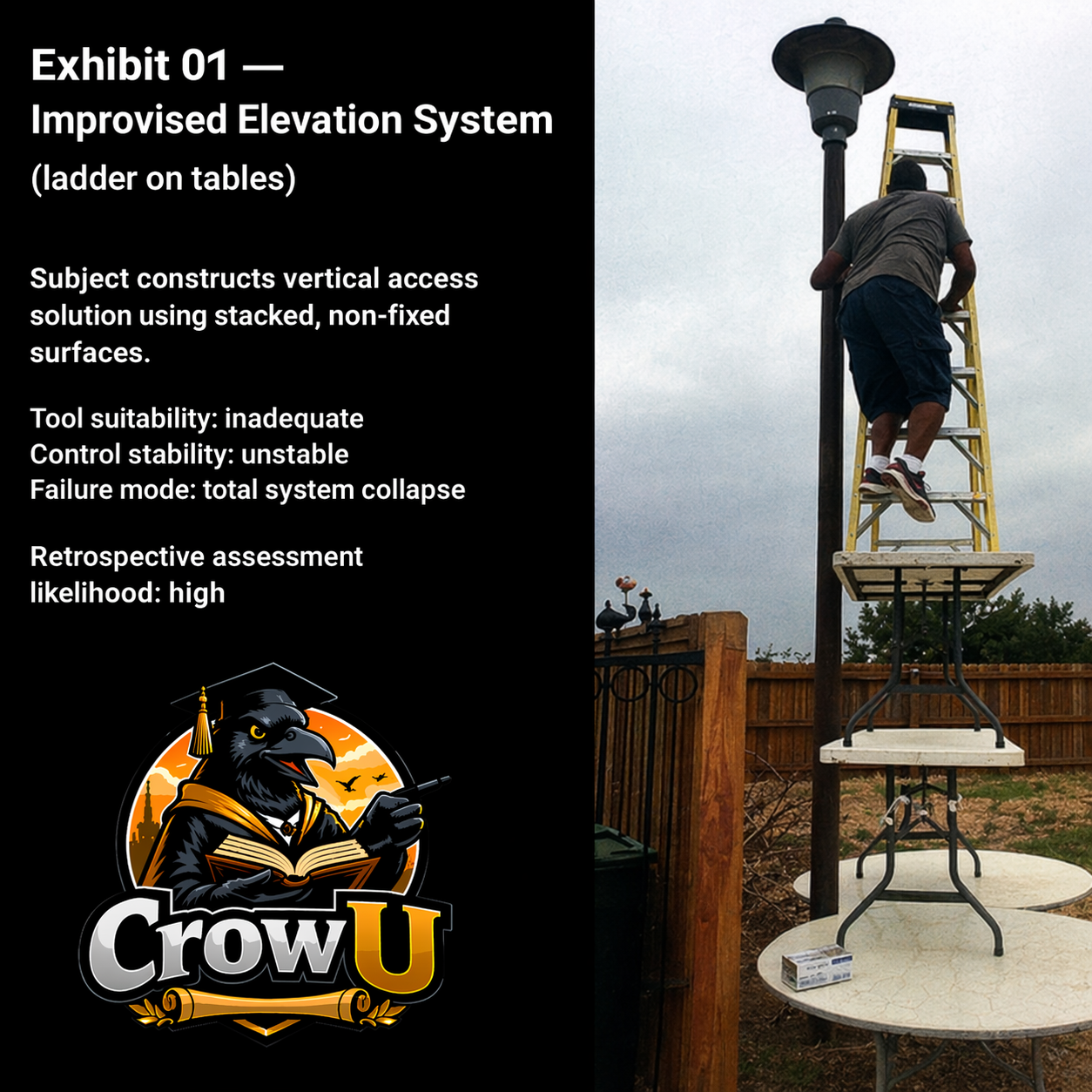
Subject constructs a vertical access solution using stacked, non-fixed surfaces, relying on the assumption that height can be substituted for stability. The base platform is offset, introducing lateral imbalance that is not corrected by the vertical anchor (lamp post), which is incorrectly treated as structural support rather than incidental contact. Load is elevated without counterweight, increasing instability exponentially. The system fails due to a fundamental misunderstanding of balance, center of gravity, and the difference between “touching something solid” and “being supported by it.”
Retrospective assessment likelihood: high
Exhibit 02. Electrical Proximity Without Isolation
The subject engages electrical infrastructure without visible insulation or grounding. Assistance is present. Protection is not.
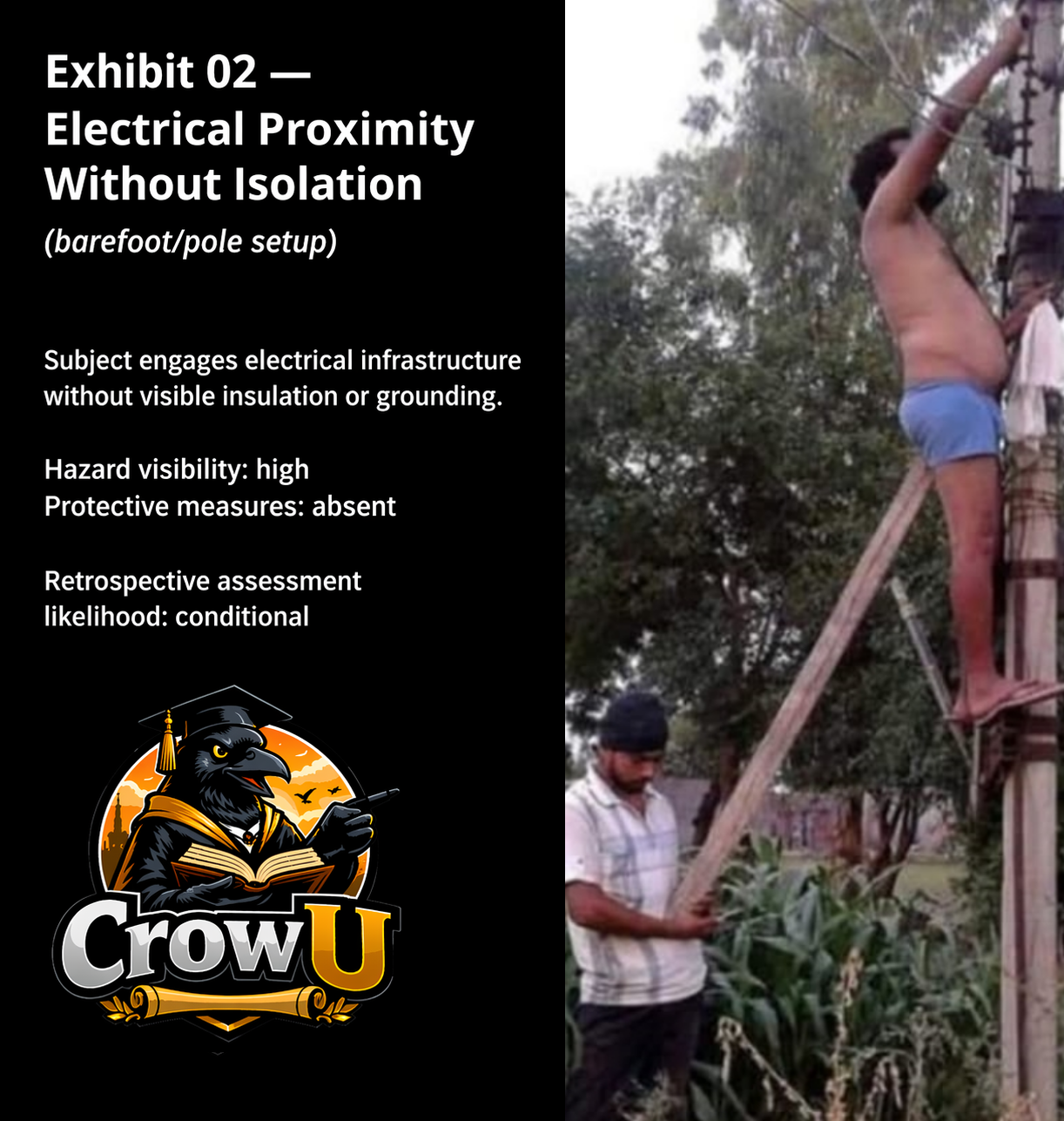
Subject engages energized infrastructure under the assumption that direct contact does not guarantee consequence. Absence of insulation, grounding, or protective equipment suggests reliance on outcome optimism rather than risk mitigation. The working model appears to be “careful equals safe,” which is not a recognized electrical safety principle. Failure mode is not gradual but instantaneous, indicating a misclassification of risk as controllable rather than binary.
Retrospective assessment likelihood: conditional
Exhibit 03. Load Support Miscalculation
The subject positions body beneath elevated load supported by unstable or uneven structure. The task proceeds as if the support arrangement has already been validated. It has not.
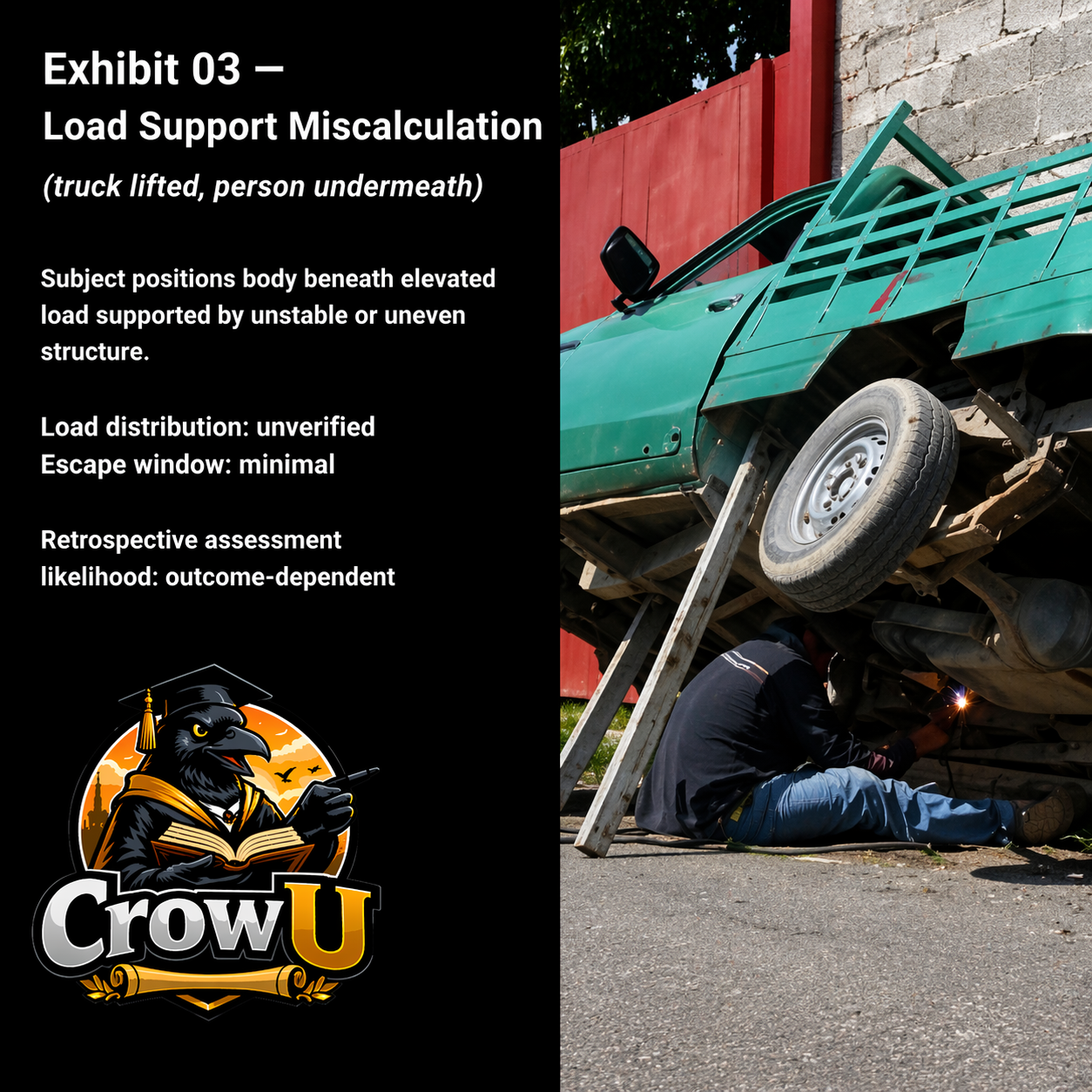
Subject positions body beneath an elevated load supported by improvised lifting methods, assuming static conditions will remain static. Load distribution is unverified, support points are unstable, and no redundant system is present. The core failure is treating temporary elevation as reliable suspension. The subject calculates “it is currently holding” as equivalent to “it will continue to hold,” which is not supported by physics or precedent.
Retrospective assessment likelihood: outcome-dependent
Exhibit 04. Suspended Task Execution
The subject performs task from unsupported exterior position without visible fall protection. Completion remains the visible priority. Gravity remains the actual supervisor.
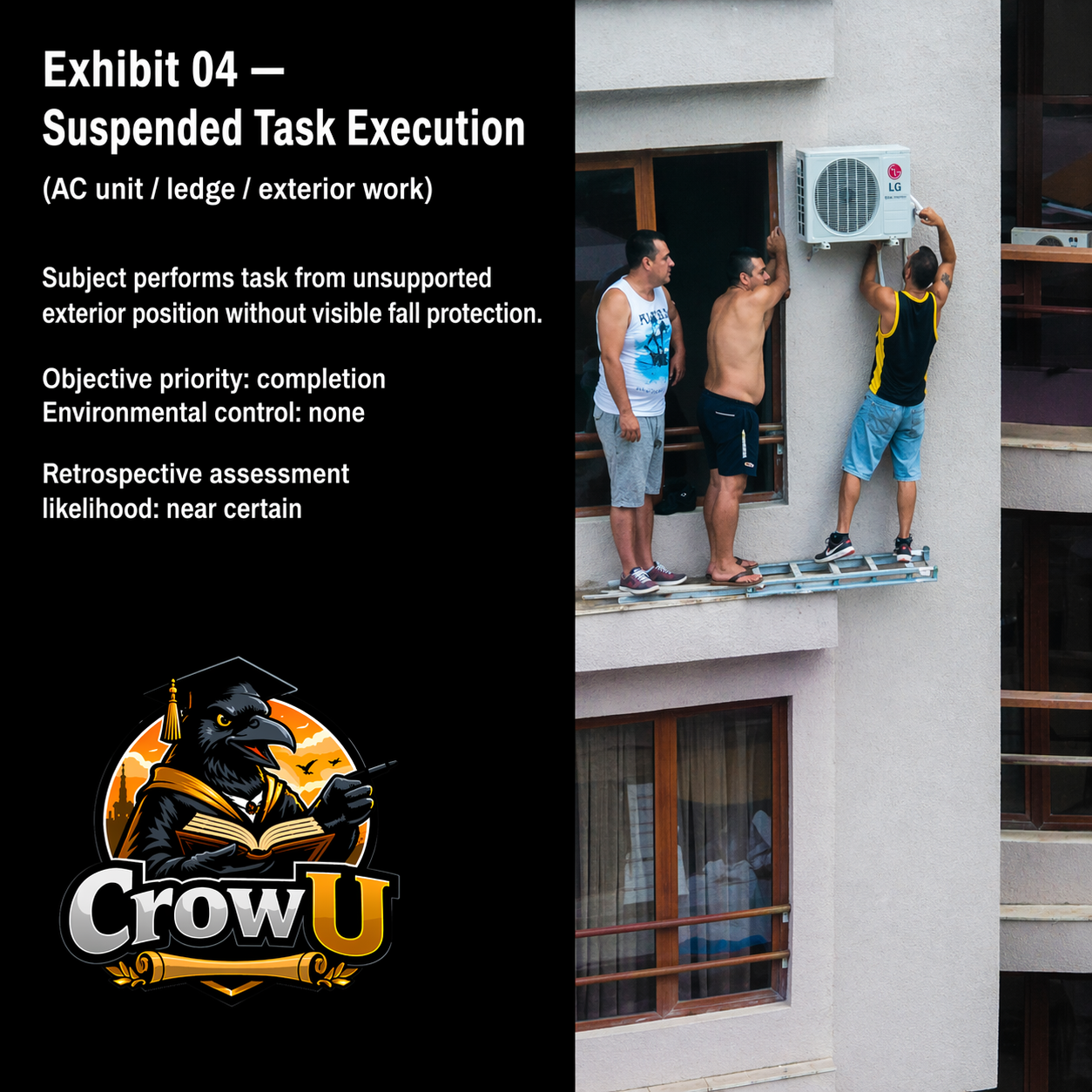
Subject performs task from unsupported exterior position without visible fall protection. The working assumption is that short duration reduces risk, which ignores the fact that failure probability does not scale with task length in the way the subject believes. The system fails due to absence of contingency planning and overconfidence in personal coordination. Completion remains the stated objective. Survival is treated as an expected byproduct rather than an engineered condition.
Retrospective assessment likelihood: near certain
Exhibit 05. Improvised Mechanical Solution
The subject uses non-specialized equipment to perform precision cutting at elevation. The machine is capable of lifting. That does not make it suitable for judgment.
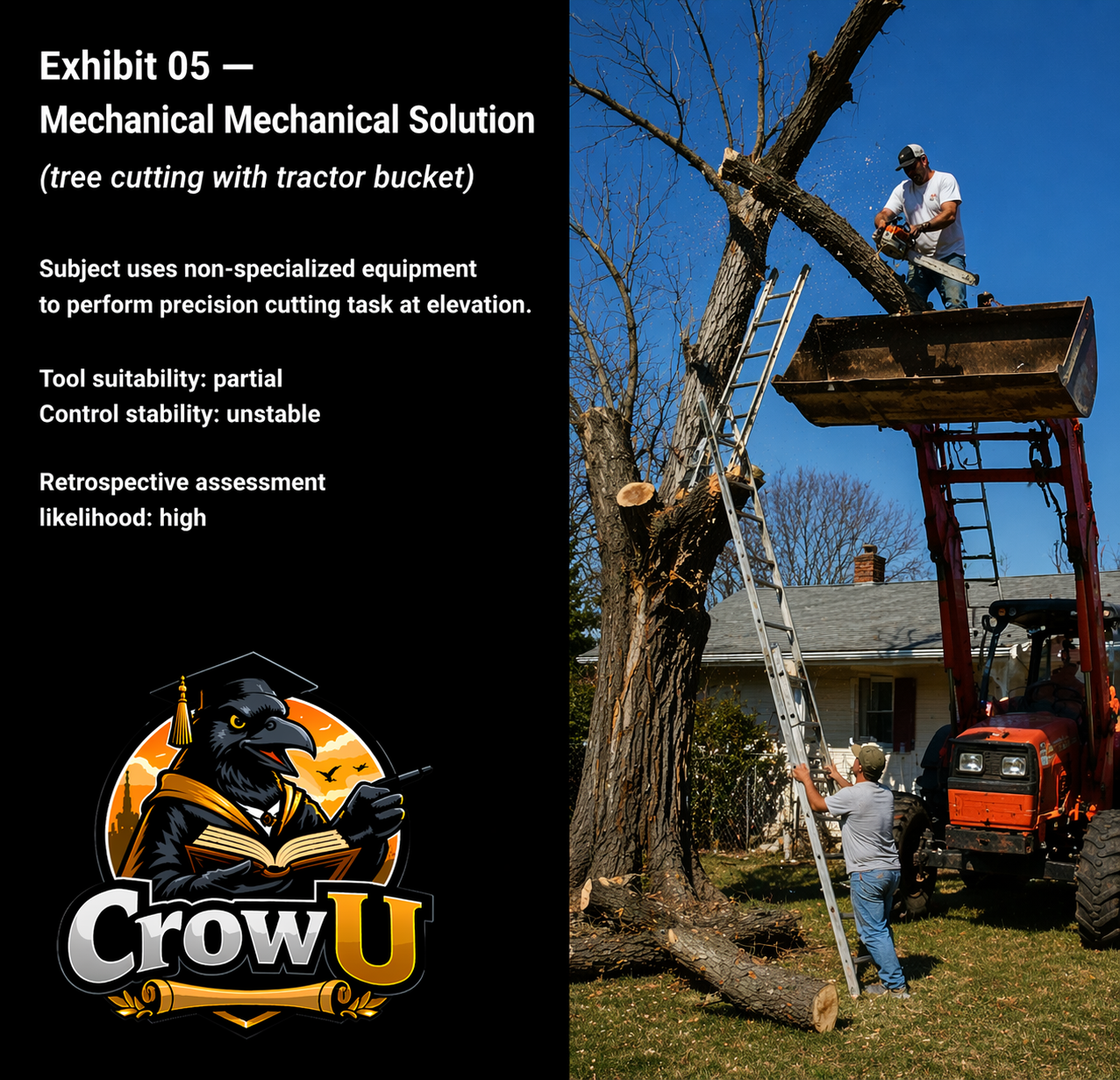
Subject uses non-specialized equipment to perform precision cutting at elevation, assuming that vertical reach substitutes for control. The bucket provides height but not stability, and the cutting action introduces dynamic forces not accounted for in the support system. The subject treats the machine as a stable platform rather than a movable base, resulting in compounding instability. Failure is driven by mismatch between tool capability and task requirement.
Control stability: unstable
Retrospective assessment likelihood: high
Observed Pattern
The exhibits do not show random foolishness. They show a repeatable sequence in which subjects mistake access for support, momentum for control, and temporary success for structural reliability. The task appears manageable. A shortcut presents itself. Confidence fills the gap where engineering should have been. From there, the subject does not re-evaluate the setup as a failing system. The subject treats the setup as work already in progress.
Visible Decision Logic
- The work needs to get done.
- The current setup appears good enough.
- The risk is assumed temporary.
- The subject expects control to hold.
Retrospective Reality
- The support system was never adequate.
- The hazard was visible from the start.
- The escape margin was minimal or absent.
- The photograph defeats the original argument.
Operational translation.
“The plan survives only until later review.”
Conclusion
Across all exhibits, subjects demonstrate consistent substitution of proximity for support, intention for control, and temporary success for structural reliability. Calculations are present but incomplete, often stopping at the point where the outcome appears achievable rather than where it becomes stable.
A secondary pattern emerges in risk attribution. Consequences are treated as negotiable, delayed, or avoidable through attention alone. This suggests not an absence of intelligence, but a selective suspension of it under conditions involving height, electricity, motion, or audience.
Longitudinal observation may offer partial explanation for population-level outcomes. Statistical lifespan differences between males and females may not be exclusively biological, but behaviorally assisted. While no single exhibit is definitive, the cumulative pattern suggests that repeated engagement in preventable failure scenarios contributes measurably over time.
Whether this tendency is hormonally influenced, culturally reinforced, or simply a recurring defect in applied reasoning remains under review. Preliminary evidence suggests the issue is not the inability to calculate, but the decision to stop calculating early.
Institutional Note. WP-005 provisionally classifies the above pattern as Deferred Recognition of Poor Decision-Making: a condition in which hazard identification becomes strongest only after the task has concluded, failed, or been photographed.
Executive Summary for People Who Don’t Read Summaries
This working paper continues Crow University’s examination of Deferred Recognition within operational environments. The findings suggest that decision failure is rarely immediate in perception, but frequently immediate in consequence.
Across observed cases, subjects demonstrate a consistent pattern of premature task validation, in which initial success is misinterpreted as structural viability. This produces a delay between action and recognition, referred to herein as “evolutionary lag.”
While traditional models assume that ineffective behavior is rapidly corrected through outcome exposure, the evidence suggests that individuals often remain confident in flawed systems until failure becomes visible, documented, or irreversible.
The study therefore concludes that in applied workplace environments, selection pressure does not eliminate poor decisions in real time. It merely archives them for later review.
Notes
- Exhibits in this paper are presented as field observations under satirical academic framing.
- Source archive: Natural Selection 2.0
- No claim is made that subjects later agreed with the conditions shown.