
Corvid Oversight in Feline Drift Management
Working Paper Status
Division: Herding Systems and Corvid Behavior Unit
Classification: Auxiliary Herding Study
Primary concern: Whether crows provide surveillance, signaling, or unofficial supervisory pressure in unstable cat environments.
WP-003 extends the institutional inquiry opened by the Cat Herding field study and considers whether corvid presence should be treated as incidental, observational, or operational in environments defined by low feline compliance and persistent directional instability.
Abstract
Cat herding remains one of the most cited metaphors for organizational impossibility, voluntary noncompliance, and group motion without durable consensus. This paper examines whether crows may occupy a useful auxiliary role in such environments. Available crow research supports a reputation for surveillance, alarm signaling, social transmission of threat information, and coordinated response to perceived risk.[1][2] While direct scientific literature on crow-led cat herding remains limited, the overlap between feline drift conditions and corvid monitoring behavior is sufficient to justify preliminary field classification.
Primary finding.
“Herding cats remains what one does. Corvid oversight remains what one studies once the cats stop pretending to cooperate.”
Statement of the Problem
Few management challenges combine motion, indifference, pride, improvisation, and total unwillingness to be managed as efficiently as a loose cat environment. A cat can be present, visible, mobile, and still operationally unavailable. Grouping multiple cats does not solve this. It multiplies it.
Crow University has therefore treated cat herding not merely as a figure of speech, but as a recurring systems failure marked by drift, fragmentation, abrupt reversals, independent routes of travel, and periodic refusal to acknowledge mission alignment.
In such conditions, line-of-sight becomes important. So does early warning. So does any species capable of observing from elevation, identifying irregular movement, and communicating that something has gone sideways.
Working premise. Once feline order breaks down, the question is no longer whether someone is watching. The question is whether that watcher is feathered.
Feline Drift Conditions
Feline drift is defined here as the tendency of cats under nominal group movement to separate into self-determined paths with no durable respect for central instruction. This may include pausing, veering, stopping entirely, doubling back, wandering into brush, or assuming that the assignment applies only to someone else.
Observed Drift Indicators
- Directional fragmentation
- Spontaneous pauses without notice
- Selective mission refusal
- Side-channel movement into unrelated space
- Visible contempt for forward progress
Oversight Conditions Needed
- Elevated visual coverage
- Rapid threat signaling
- Group-wide alert capacity
- Willingness to remain involved without thanks
Filed observation. The average cat does not join a program. It enters a setting and then negotiates separately with reality.
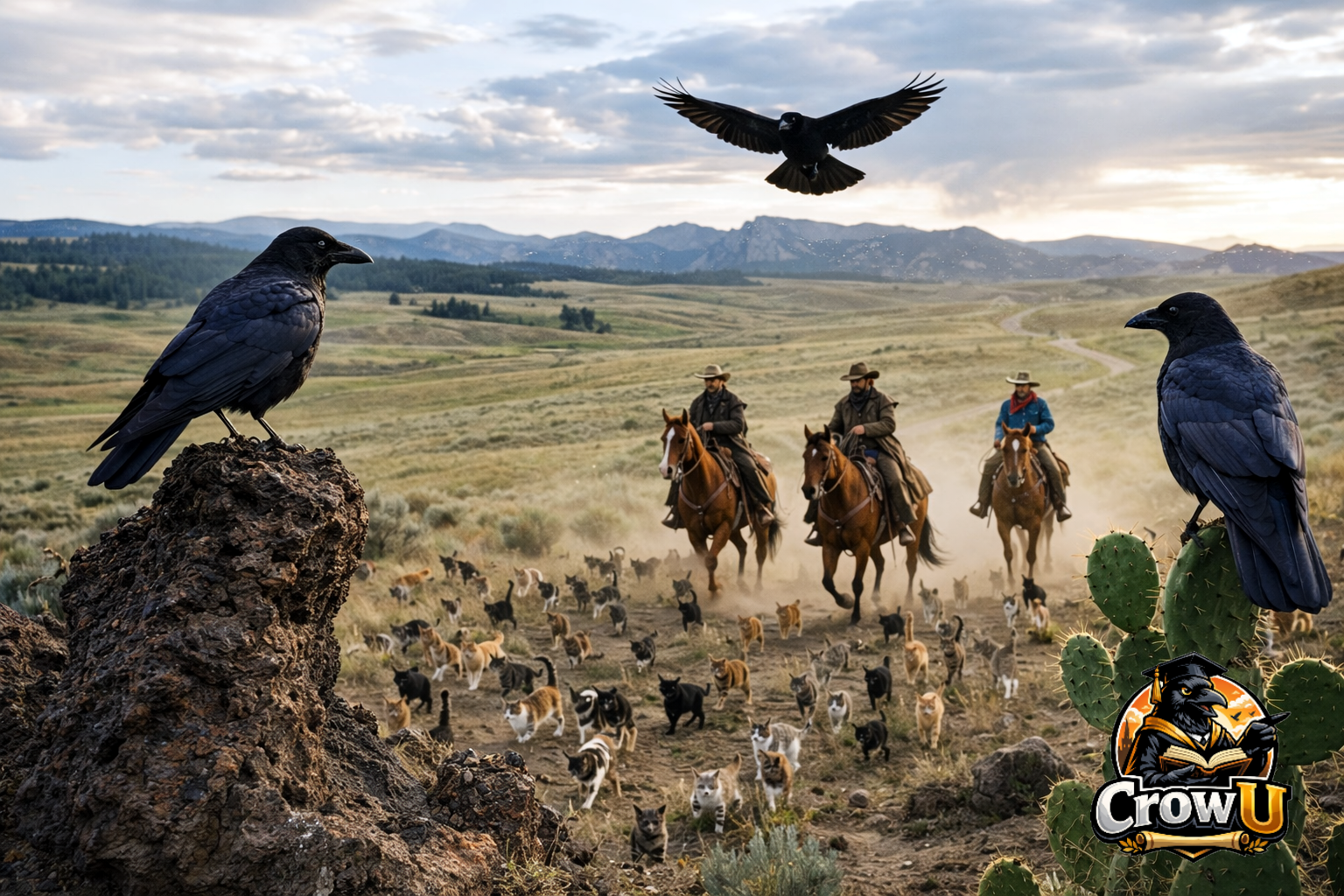
Exhibit A. Proposed field model showing mounted personnel managing feline drift under active corvid oversight. Note elevated non-intervention. Click to enlarge.
The first exhibit presents the expanded field model: mounted personnel attempting directional control over a broad cat movement while crows occupy visible oversight positions. The crows are not shown issuing commands. That would be implausibly direct. They are shown doing what corvids do best: watching everything.
Corvid Observation and Alarm Function
American crows are well documented as alert, social, and highly responsive to danger. Research has shown that crows learn to identify threatening humans and spread that knowledge socially through alarm behavior and group response.[1] Cornell Lab materials also describe coordinated mobbing behavior in crows against predators and other threats.[2]
That does not amount to a formal herding manual. It does, however, support the narrower institutional claim that crows are well equipped for oversight in unstable ground conditions. They see movement. They note irregularity. They object loudly when something unwelcome appears. Those are not trivial contributions in a field already failing at order.
Operational translation.
“The crow may not move the cat directly, but it is fully capable of identifying where the problem is, announcing it, and ensuring nobody nearby enjoys the experience.”
Do Crows Play Well with Others?
None of this should be read as an institutional claim that crows do not play well with others. They do. Crows remain fully capable of coordinated signaling, negotiated tolerance, opportunistic alliance, and mutually beneficial association where circumstances warrant.
They may not volunteer for every partnership, but when a situation becomes noisy, territorial, or inefficient, they have shown no shortage of interest in participating on their own terms.
The issue is species identity, not social capacity. Crows may not volunteer for every partnership, but when a situation becomes noisy, territorial, or inefficient, they have shown no shortage of interest in participating on their own terms.
The distinction is taxonomic, not temperamental.
Crow vs. Raven: Taxonomy, Temperament, and Professional Bearing
Crows and ravens are not the same species. They are close kin within the corvid family, and several are housed within the genus Corvus. The American crow is Corvus brachyrhynchos. The common raven is Corvus corax.[3]
For purposes of public confusion, this distinction is often ignored. For purposes of working-paper integrity, it should be kept. This paper remains crow-centered. Raven material is relevant only in the limited sense that nearby corvid findings may occasionally help clarify broader questions of oversight, signaling, and professional posture.
That is not to say crows lack cooperative instinct. The distinction is taxonomic, not temperamental. In professional bearing, the difference is largely stylistic. Ravens often seem determined to demonstrate their usefulness. Crows carry themselves as if usefulness is already understood.
Corvid Proximity Doctrine. While crows and ravens are not taxonomically identical, Crow University recognizes them as sufficiently adjacent for limited comparative use in supervisory theory, warning behavior, and field interpretation.
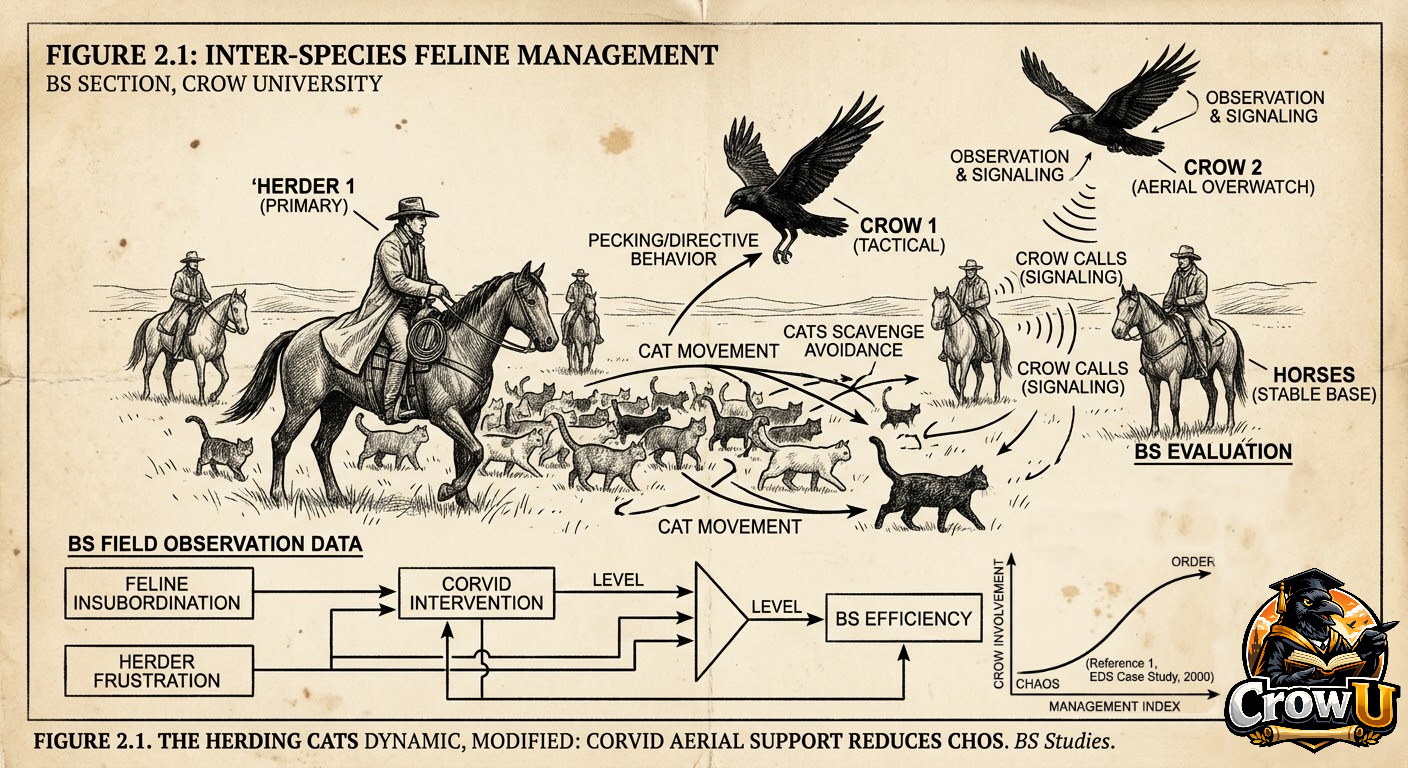
Exhibit B. Inter-Species Feline Management Model
The second exhibit shifts from field imagery to institutional analysis. Presented here is a working diagram of inter-species feline management showing proposed relationships among mounted herders, cat movement, corvid observation, signaling, and measured B.S. efficiency under unstable conditions.
Preliminary Oversight Model
Based on available evidence, Crow University proposes a limited oversight model rather than a direct-herding model.
Cat environments predictably generate drift, fragmentation, and local management breakdown.
Crows possess the surveillance, signaling, and social-warning traits most relevant to identifying and reacting to unstable movement.[1][2]
The strongest scientific bridge for broader cross-species coordination remains raven-wolf literature, which supports the plausibility of corvid participation in complex field relationships.[4]
Institutional summary.
“The cat remains unmanaged. The crow remains informed. That alone may qualify as progress.”
Conclusion
Crow University does not conclude that crows have solved cat herding. No honest institution could. It concludes something narrower and more defensible: where cats drift, crows frequently appear well suited to observe, signal, and maintain situational awareness above the disorder.
In some environments, that role may be incidental. In others, it may be indispensable. Either way, the repeated appearance of corvid attention around unstable cat conditions should no longer be dismissed as decorative background activity. The final exhibit, taken under conditions of advanced feline fragmentation, suggests a crow not merely present but positioned — as if the question of who holds operational awareness has already been settled.
Herding cats remains what one does. Corvid oversight remains what one studies once the cats stop pretending to cooperate.
Institutional Note. Following peer review and upgraded visual documentation, WP-003 is elevated from Auxiliary Herding Study to Established Field Observation. The Herding Systems and Corvid Behavior Unit has opened a related inquiry into whether sustained corvid disapproval constitutes a measurable intervention, tentatively expressed in disapprovals per minute (DPM).
References
- Cornell, H. N., Marzluff, J. M., & Pecoraro, S. “Social learning spreads knowledge about dangerous humans among American crows,” Proceedings of the Royal Society B. Open source
- Cornell Lab of Ornithology, “Crows Cope With Family Values, City Living, and West Nile Virus.” Open source
- Scientific Reports, corvid comparative genomics / taxonomy reference. Open source
- Science, “Ravens anticipate wolf kill sites across broad scales.” Source