
Why Crow Eggs Do Not Exist
Working Paper Status
Division: Avian Symbolism and Access Control Unit
Classification: Public Access Failure Study
Primary concern: Why robin eggs got branding while crow eggs remained under seal.
Working Paper WP-002 extends the unresolved Crow Eggs question first raised in WP-001, The Candy Holy Trinity, and advances the preliminary institutional finding that crow eggs did not disappear by nature. They disappeared by branding.
Abstract
This paper examines the long-standing public absence of crow eggs from seasonal symbolism, retail culture, decorative tradition, and ordinary conversation. While robin eggs secured broad cultural recognition through color, visibility, and springtime branding, crow eggs remained effectively nonexistent in the public imagination. This study argues that such absence is not biological, but administrative, symbolic, and reputational. The robin benefited from aesthetic compliance. The crow suffered from unmanaged public perception despite superior intelligence, memory, social transmission of threat information, and a demonstrated capacity for selective reciprocity.[2][3][4]
Primary finding.
“The robin sold spring. The crow never hired marketing.”
Statement of the Problem
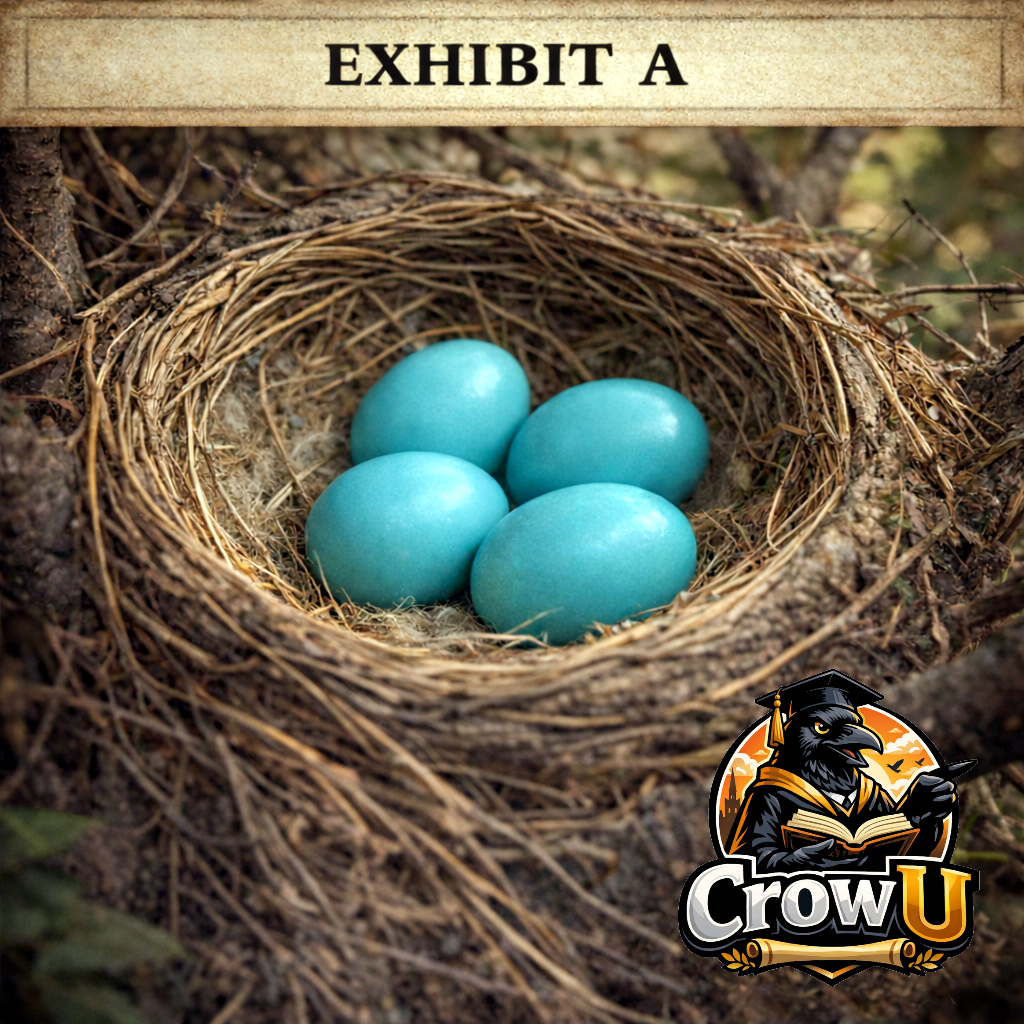
Most people have heard of robin eggs. Many can describe them instantly. They are blue, delicate, seasonal, and treated as if spring itself signed off on their release. Cornell’s robin life-history materials describe American Robin eggs as sky blue or blue-green and unmarked.[1]
By contrast, crow eggs remain largely absent from common public consciousness. The average person may know that crows exist, may see them often, and may even distrust them slightly, yet still has no working mental image of a crow egg.
A bird of high intelligence, deep historical presence, social complexity, and impressive adaptive ability has been culturally outperformed by a bird whose principal public strengths are visual softness, egg coloration, and favorable spring branding. The question is not whether crow eggs exist in nature. They do. The question is why they do not exist in the public mind.
Exhibit A. Robin Egg Familiarity
The first exhibit reinforces the standard public image: robin eggs as simple, iconic, and immediately recognizable.
The Robin Public Relations Monopoly
Robins won the public-relations war early and never looked back.
They are bright-chested, easy to sentimentalize, nonthreatening in appearance, and strongly associated with seasonal renewal. Their eggs are visually pleasing, highly recognizable, and perfectly suited to pastel merchandising. The robin entered the public imagination not on the basis of demonstrated superiority, but on the basis of market compatibility.
Robin eggs became familiar because they were photogenic, retail-friendly, and emotionally convenient. They asked nothing of the observer beyond a mild appreciation for color and weather. They were easy to place on greeting cards, candy wrappers, nursery walls, and seasonal décor. Their public success was not earned through exceptional conduct. It was earned through branding.
Crow eggs, meanwhile, received no such assistance. No soft-focus campaign humanized them. No pastel economy adopted them. No public institution stepped forward to say, “Perhaps the more intelligent bird deserves equal symbolic standing.”
Working conclusion. The public did not choose the better bird. It chose the better campaign.
Comparative Aesthetic Review
A common assumption underlying the robin egg monopoly is that crow eggs must be visually unremarkable. This assumption does not survive visual review.
Robin eggs are famous for one iconic trait: uniform blue. They are clean, simple, and instantly legible. Crow and broader corvid eggs, by contrast, often present pale bluish-green to olive tones with brown or gray blotching, mottling, tonal variation, and a more textured, mineral-like finish.[1] Robin eggs offer immediate recognition. Crow eggs offer depth.
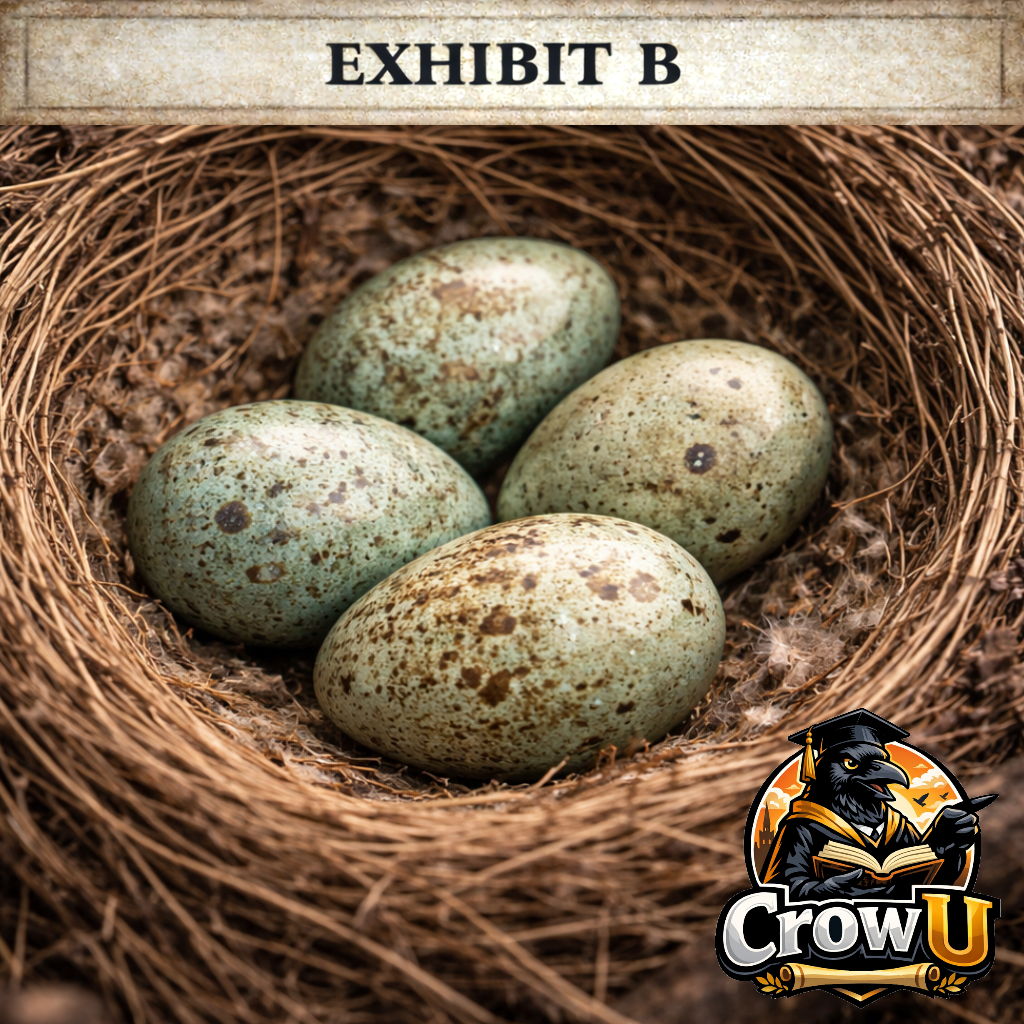
This matters because the public story has long implied that robin eggs won on beauty. The available visual evidence suggests a different conclusion. Robin eggs won on simplicity. Crow eggs were overlooked despite sophistication.
Comparative finding.
“The robin had better publicity. The crow family had better product.”
Crow Competence and Public Discomfort
Crows present a problem for the casual observer. They are too aware.
Research associated with John Marzluff and the University of Washington has shown that crows can recognize specific human faces and associate them with negative or positive experiences.[2] A published study in Proceedings of the Royal Society B further showed that social learning spreads knowledge about dangerous humans among American crows.[3]
In practical terms, once a crow identifies a person as a problem, the matter may not remain private.
The American public mistook friendliness for virtue and mystery for menace. The robin benefited from appearing harmless. The crow was penalized for looking like it knew something. Dark feathers, strong posture, coordinated behavior, and visible unwillingness to participate in soft branding all contributed to its misclassification as ominous rather than exceptional.
Egg Visibility, Access Control, and Nest Security
A common response to the crow egg question is that crow nests are simply harder to access or observe. This explanation is technically useful and emotionally incomplete.
At some point, rarity becomes policy.
A species capable of facial recognition, long-term memory, territorial enforcement, and socially distributed threat response cannot reasonably be assumed to mismanage reproductive confidentiality. If crows can circulate threat intelligence, they can certainly maintain egg secrecy.[2][3]
The public does not lack curiosity. It lacks clearance.
Unauthorized nest proximity is frequently discouraged through vocal warnings and dive-bomb behavior. These responses have often been interpreted as instinctive aggression. A more disciplined reading would classify them as access-control measures. Under this framework, crow eggs do not fail to exist. They fail to obtain public release.
Filed observation. Robin eggs entered the seasonal marketplace. Crow eggs remained under seal.
Gift Conduct, Memory, and Relational Merit
The cultural imbalance becomes harder to defend when one considers relational conduct.
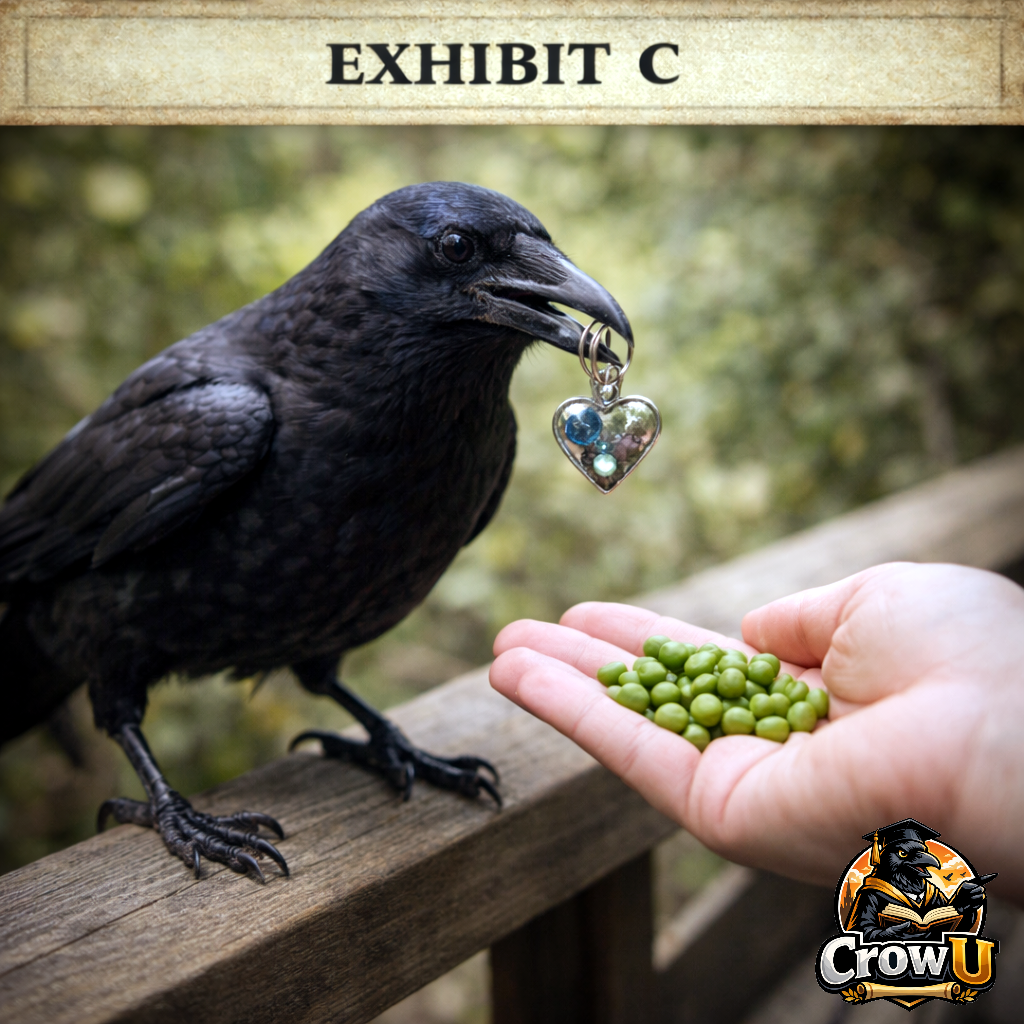
Audubon has reported on observed crow “gift” behavior toward humans who feed them, while also noting that crows recognize individual people and learn from one another.[4] The point is not that every crow becomes a jeweler. The point is that crows display a level of selective memory, evaluation, and reciprocity that materially exceeds their public stereotype.
Robin Contribution
- Visual familiarity
- Seasonal softness
- Decorative compliance
- Low public stress profile
Result: retail comfort.
Crow Contribution
- Face recognition
- Threat intelligence
- Long memory
- Occasional selective reciprocity
Result: earned regard.
One bird became famous for decorative eggs and harmless spring energy. The other remembers faces, shares threat intelligence, and may eventually leave tribute. Yet the softer bird got the gift shop while the more accomplished bird got suspicion.
Field frustration, documented.
“When was the last time a robin brought anybody anything but noise and droppings?”
Seasonal Misallocation of Egg Symbolism
If robins were awarded Easter, crows should have been granted Halloween.
Robin eggs were admitted into spring on the basis of color compliance. Crow eggs were denied autumn placement despite overwhelming atmospheric qualification. If one seasonal egg represents softness, rebirth, and pastel domesticity, another should be allowed to represent mystery, intelligence, earned trust, and controlled access.
A proper crow egg confection would not be baby blue. It would be dark, lacquered, gold-flecked, and probably unavailable without clearance.
Seasonal Rights Memorandum
The robin received spring distribution. The crow was routed to autumn under ornamental suspicion.
This was a merchandising failure, not a symbolic inevitability.
Preliminary Findings
Crow eggs are publicly absent not because they are biologically obscure, but because the culture over-rewarded visual friendliness and under-recognized avian sophistication.
Robin eggs became culturally dominant through branding, not through demonstrated superiority.[1]
Institutional summary. The robin is recent sentiment. The crow is ancient standing.
Conclusion
Crow eggs do not fail to exist in nature. They fail to enter public circulation.
That failure reflects a broader cultural habit: preferring what is soft, visible, and immediately comforting over what is intelligent, watchful, and difficult to sentimentalize. The robin benefited from branding. The crow suffered from profiling. One was marketed. The other was misunderstood.
The public received robin eggs, pastel compliance, and decorative certainty. It was denied crow eggs, earned mystery, and a much better story.
Crow University considers this a preliminary finding, not a final one.
Supplementary Field Sources
References
- Cornell Lab of Ornithology, All About Birds, “American Robin Life History.” Open source
- University of Washington, “Crows react to threats in human-like way.” Open source
- Cornell et al., “Social learning spreads knowledge about dangerous humans among American crows,” Proceedings of the Royal Society B. Open source
- Audubon, “Did Crows Actually Make These Gifts for the Human Who Feeds Them?” Open source