
The Candy Holy Trinity
Working Paper Status
Division: Confectionery Observation Unit
Classification: Seasonal Behavioral Study
Primary concern: Why the minis are perfection and the big bulky ones are not.
Working Paper WP-001 documents a recurring seasonal confectionery phenomenon in which otherwise reasonable adults recognize the likely consequences of overconsumption and proceed anyway.
Abstract
Each Easter season, consumers once again encounter a confectionery object known as the Robin Egg. Some buy a bag, enjoy a few pieces, and move on. Others experience a more significant event. They become aware that the Robin Egg is not merely candy. It is a layered sensory structure with a very specific internal balance.
Through repeated seasonal observation, Crow University researchers have concluded that the enduring appeal of the Robin Egg is best explained by what we now describe as The Candy Holy Trinity: the snap of the shell, the melt of the chocolate, and the final airy crunch of the malt center.
Further study has revealed that not all Robin Eggs perform equally. In particular, the mini variety appears to achieve a superior ratio among these three essential elements, producing a more balanced and more satisfying confectionery experience than the larger, bulkier version.
Field Subject Report — Participant 07.
“The candy shell, the milk chocolate, and the malt center appear to be working together in the way the good Lord intended.”
Figure 1. Structural Anatomy of the Robin Egg
A labeled structural diagram is presented below in thumbnail form for routine catalog review.
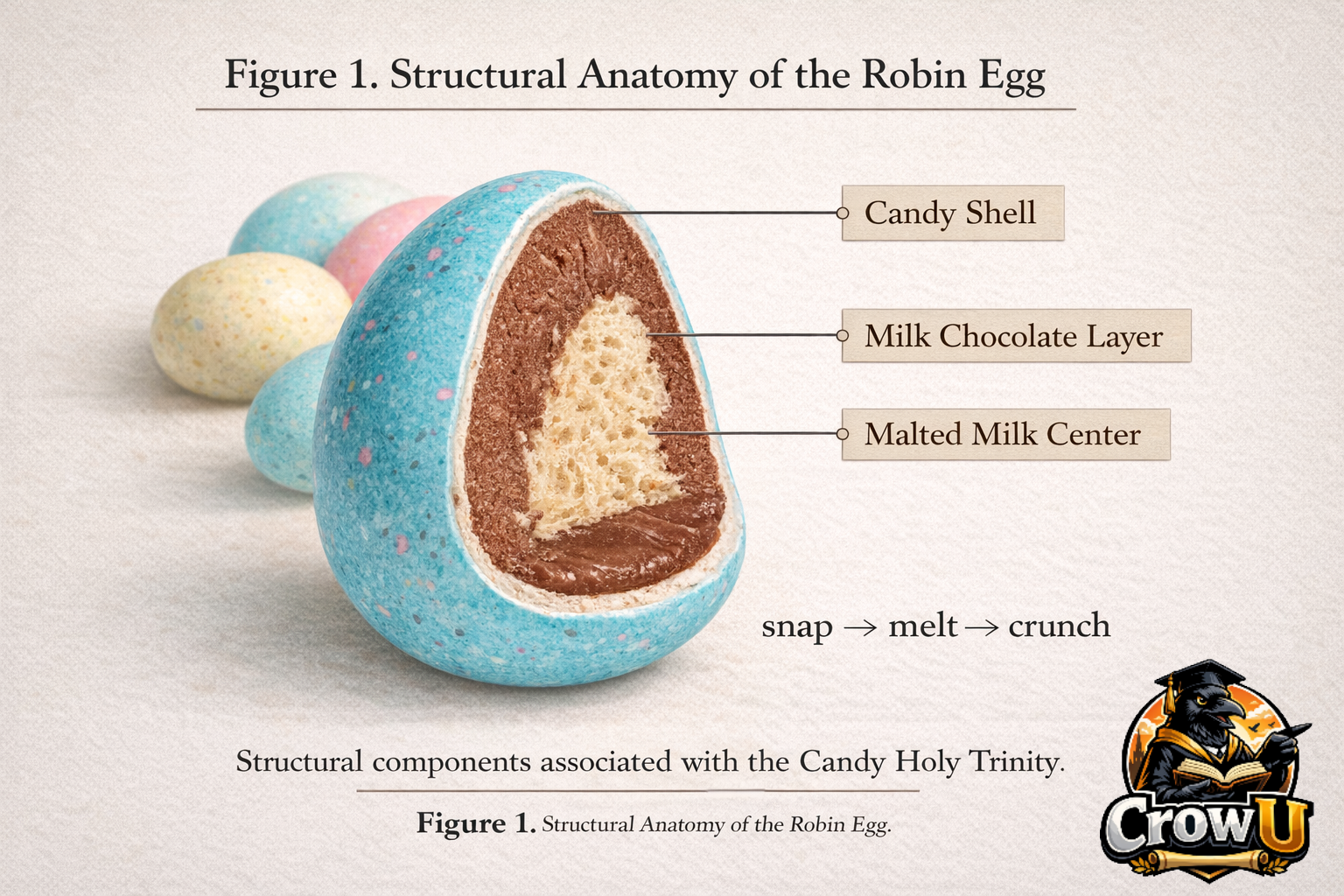
The Candy Holy Trinity
A proper Robin Egg does not arrive all at once. It unfolds in stages. This layered progression is central to its appeal and is the core finding of the present study.
Preliminary observation suggests that the Trinity operates as a timed sequence rather than a single flavor event. The shell initiates the opening signal, the chocolate transition moderates the sweetness load, and the malt center completes the structural handoff.
The candy shell provides the opening event: a clean crunch and a quick burst of sweetness. It functions as the entry signal and delivers the first immediate reward.
Immediately after the shell breaks, the milk chocolate softens and rounds out the sweetness. This transition adds richness and prevents the experience from collapsing into mere sugar.
The malted milk center finishes the sequence with a lighter, airy crunch. Alone, the Whopper center is merely acceptable. In this setting, it becomes structurally indispensable.
This progression explains why Robin Eggs feel more complex than ordinary candy. They are not simply sweet. They are sequential. The pleasure lies in the ordered handoff from one texture to the next.
The Mini Robin Egg Discovery
Casual observers often assume that the large Robin Egg and the mini Robin Egg are functionally identical. This is incorrect. They may share ingredients, but they do not share balance.
Mini Robin Eggs
The mini version appears to achieve what researchers now classify as the Optimal Trinity Ratio.
- Better shell presence per bite
- More immediate chocolate contact
- Less bulky malt dominance
- Tighter, cleaner texture sequence
Result: confectionery harmony.
Large Robin Eggs
The larger version suffers from a disproportionate center profile and a reduced sense of balance.
- Heavier malt center
- Less precise shell-to-chocolate impact
- Greater risk of center-heavy texture
- Reduced elegance of delivery
Result: a bulky and less satisfying experience.
In short, the minis are not merely smaller. They are better. Those who claim otherwise are revealing that they are not, in fact, Robin Egg aficionados.
On the Mystery of “Limited Time Only”
Robin Eggs are not merely marketed as seasonal. They are actually seasonal. They appear, they flood the market, they vanish, and they do so with enough consistency to create real urgency among experienced consumers.
One plausible explanation is structural. Because the product relies on a malt center, long-term storage may degrade quality. A broad seasonal release allows inventory to move quickly before texture loss, staleness, and customer disappointment begin to set in.
This creates a distinctive consumer pattern: the product returns briefly, demand spikes, shelves thin out, and otherwise reasonable adults begin making statements they would not normally make in public about their willingness to part with cash for an off-season bag.
Comparable Seasonal Logic
In the Gulf South, crawfish season operates under a similar suspension of normal restraint. People eat it repeatedly because the window is limited, the availability is temporary, and the logic of the season overrides ordinary judgment.
Robin Eggs appear to operate under the same seasonal indulgence principle. Any temporary weight gained during a true seasonal confectionery event should be understood as ceremonial and therefore not spiritually binding.
The Dark Side of the Candy Holy Trinity
One of the more curious findings of this study is that Robin Egg consumers often continue eating the product even after fully understanding the likely consequences. This is not ordinary enjoyment. It suggests a stronger behavioral pull.
Test subjects consistently report that Robin Eggs do not merely taste good. They create a repeating cycle of desire, overconsumption, regret, and return. Several participants declined to estimate their total seasonal consumption, with one noting it was “a number I’m not prepared to defend.”
Preliminary Behavioral Pattern
- Initial purchase framed as “just one bag”
- Rapid overconsumption driven by crunch, sweetness, and texture layering
- Resulting sugar rush, headache, and sincere self-reproach
- Temporary vow never to do this again
- Renewed purchase at a later date despite full awareness of prior outcome
The most likely explanation is not a single flavor note, but the repeated sequencing of sensations. The shell snaps, the chocolate melts, and the malt center crunches. Each stage hands off neatly to the next, creating a highly rewarding cycle that encourages “just one more” behavior far beyond the point of good judgment.
This helps explain why otherwise reasonable adults continue consuming Robin Eggs even while anticipating the aftermath. They are not simply chasing sweetness. They are chasing the full return of the Candy Holy Trinity.
Researchers have identified a recurring condition known as Candy Remorse: the period immediately following overconsumption in which the subject feels physically miserable, emotionally disappointed, and yet remains fully willing to repeat the behavior at a later date.
Further study is warranted. At minimum, Crow University believes Robin Eggs display a noteworthy convergence of qualities associated with repeat-consumption behavior: limited availability, layered texture, rapid reward, and a strong nostalgia component. For related findings on repeating behavioral cycles under conditions of partial awareness, see the B.S. Core.
Future Research
The present paper leaves several important questions unresolved.
- Why do the minis often disappear first?
- Could an off-season preservation method maintain structural integrity?
- If Robin Eggs exist, why do Crow Eggs not?
Crow University would like to formally encourage the confectionery industry to explore the possibility of a darker, more sophisticated companion product tentatively known as Crow Eggs.
Preliminary Crow Egg Product Development Note
Proposed characteristics include a darker shell, a richer chocolate profile, and a more serious aesthetic suitable for advanced seasonal consumers. The Confectionery Observation Unit stands ready to assist with taste testing, structural analysis, and shell-color consultation should any manufacturer wish to proceed.