
Corvid–Canid Coordination: A Field-Tested Oversight Model
Working Paper Status
Division: Corvid–Canid Systems Review Unit
Classification: Cooperative Field Model Study
Primary concern: Whether inter-species coordination in wolf-corvid systems has been underread as wildlife behavior and underused as administrative precedent.
WP-004 follows WP-003, Corvid Oversight in Feline Drift Management, and broadens the inquiry from satirical ground disorder to documented natural precedent. If WP-003 asked whether corvid oversight might exist in unstable systems, WP-004 notes that nature appears to have been running the pilot program for some time.
Abstract
This paper examines the persistent record of coordination between wolves and corvids, especially ravens, and considers the larger implications of that relationship for supervisory theory, signaling models, and distributed oversight. Formal literature most often centers on ravens in wolf-associated feeding systems, including evidence that ravens anticipate wolf kill sites across broad areas and benefit from wolves opening access to carcasses.[1][2] At the same time, broader public discussion frequently substitutes “crow” and “raven” with notable ease. Crow University treats this not as a fatal defect, but as an informative feature of the record.
Primary finding.
“Nature has already field-tested interspecies coordination. Administration is merely late to the file.”
Statement of the Question
If wolves manage ground enforcement and corvids manage aerial awareness, what exactly are we looking at?
The answer need not be sentimental to be significant. One species closes distance. The other closes the information gap. One opens the resource. The other locates, signals, and converges. Whether or not either side would describe this as cooperation is beside the point. The pattern remains visible.
Crow University therefore treats the wolf-corvid record as more than an ecological curiosity. It is a field-tested model of distributed advantage operating without committee language, organizational charts, or anyone pretending the arrangement was invented by management.
Working premise. When the same sequence repeats often enough in the wild, administration eventually loses the right to call it informal.
Why Wolves Matter
Wolves matter because they change what is accessible on the ground.
A corvid can detect, scout, follow, and announce. It cannot reliably open a large carcass on its own. A wolf can. This creates an asymmetry of capacity that turns simple proximity into functional alignment. The corvid supplies information mobility. The wolf supplies physical access. Neither contribution is minor. Both appear repeatedly.
Canid Ground Role
- Closes distance
- Processes resource
- Establishes terrestrial access
- Changes site conditions for all later arrivals
Corvid Air Role
- Scouts widely
- Signals rapidly
- Tracks site opportunity
- Converges with minimal delay
Filed observation. The wolf handles ground enforcement. The corvid handles early awareness.
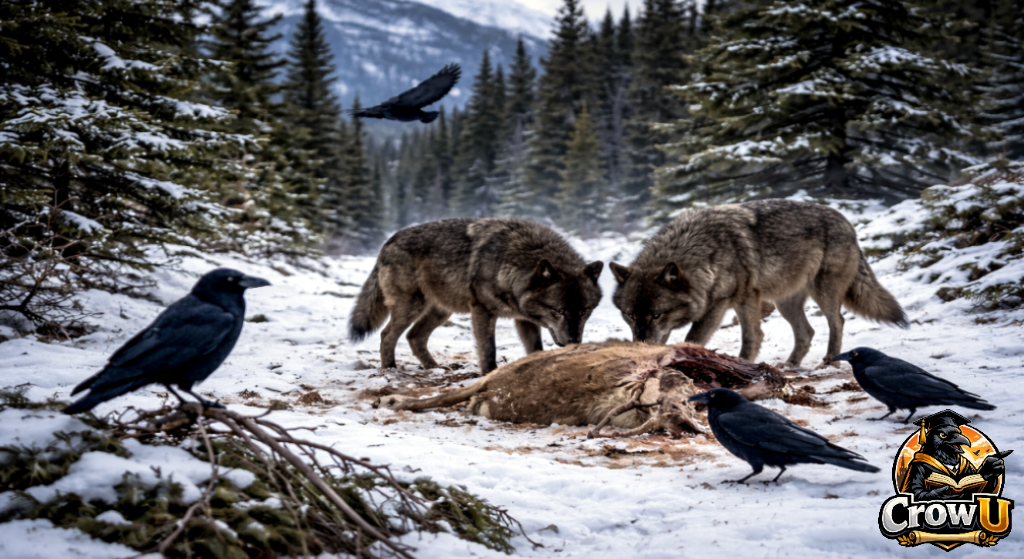
Exhibit A. Corvid–Canid Interaction at Shared Resource Site
The first exhibit presents the field version of the problem: wolves at a winter carcass site, multiple corvids positioned around the resource, and one bird overhead rather than feeding. This is the important detail. Not every participant is acting as a feeder. At least one appears to be acting as a watcher.
Raven–Wolf Cooperative Evidence
The strongest formal record centers on ravens. Published work has documented ravens preferentially associating with wolves, reducing fear around novel food sources when wolves are present, and anticipating wolf kill sites across broad areas.[1][2]
None of this requires a sentimental reading. The point is narrower and more useful: repeated cross-species benefit produces consistent behavioral alignment. The raven does not need a badge. The wolf does not need a memo. The system works anyway.
Operational translation.
“One species enforces. The other informs. Neither files a report.”
Terminological Drift in Corvid–Canid Literature
A recurring feature of the literature and its surrounding public discussion is the fluid substitution of “crow” and “raven,” sometimes within the same discussion and occasionally within the same paragraph. This may reflect taxonomic imprecision. It may also reflect the fact that, under cooperative conditions, the distinction becomes operationally inconvenient.
Crow University does not treat that slippage as ideal. It treats it as data. Once observers begin describing a role rather than a species, the language itself starts revealing what the system is doing.
Institutional position. Terminological instability in the record is retained as submitted.
Crow vs. Raven: Operational Nearness and Professional Bearing
Crows and ravens are not the same species. They are close kin within the corvid family, and several are housed within the genus Corvus. The American crow is Corvus brachyrhynchos. The common raven is Corvus corax.[3]
Formal wolf-associated literature favors ravens. Crow University acknowledges that plainly. It also notes that the broader corvid implications are difficult to ignore once signaling, scouting, resource timing, and supervisory posture enter the discussion.
In professional bearing, the difference remains largely stylistic. Ravens often appear intent on demonstrating usefulness. Crows tend to operate as if usefulness has already been established (see Corvid Proximity Doctrine, WP-003).
Corvid Proximity Doctrine. While crows and ravens are not taxonomically identical, Crow University recognizes them as sufficiently adjacent for limited comparative use in oversight theory, warning behavior, and administrative interpretation.
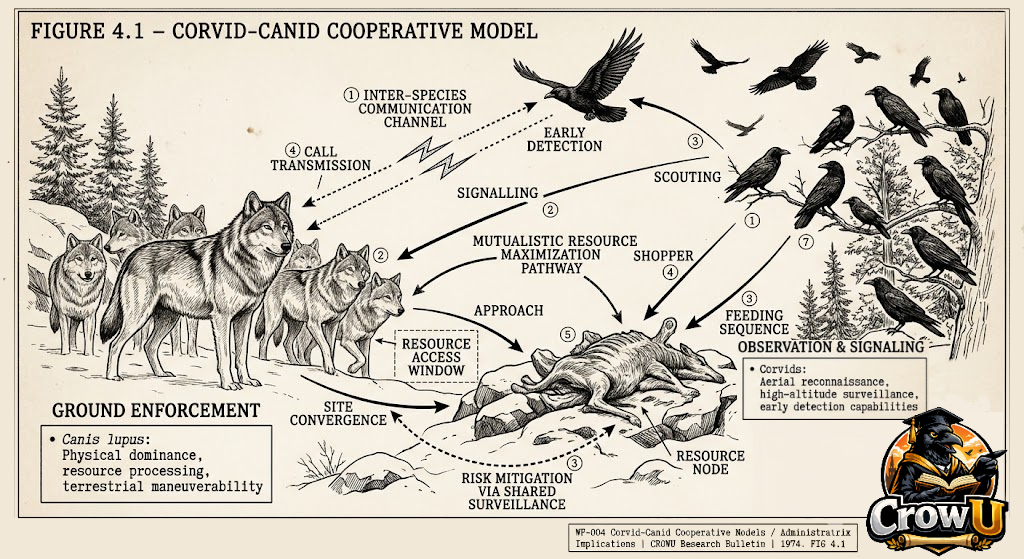
Exhibit B. Corvid–Canid Cooperative Model
The second exhibit shifts from field observation to institutional analysis. Presented here is a working model of corvid–canid cooperation showing early detection, signaling, approach, site convergence, and resource access under distributed oversight conditions.
Asymmetric Effort and Opportunistic Advantage
Corvid intelligence is well documented. Tool use, problem solving, and long-range memory place several corvid species among the most cognitively capable animals in the non-human world. These traits do not, however, obligate the corvid to perform unnecessary labor.
The wolf opens the carcass. The corvid arrives informed.
From a strictly operational standpoint, this creates an asymmetry of effort. One participant performs the physically intensive task required to make the resource accessible. The other benefits from timing, awareness, and positioning. No instruction is issued. No agreement is signed. The distribution of labor nonetheless remains consistent.
Crow University does not conclude that corvids direct wolves. That would require evidence of command authority. It does note that, in repeated field conditions, corvids appear to derive maximum benefit from events in which they perform minimal physical work.
Operational interpretation.
“The crow does not need to control the wolf. It only needs the wolf to do what the wolf was already going to do.”
This raises a narrower question than control, but a more durable one: whether the relationship represents balanced mutual benefit or a system in which one side consistently captures advantage through timing, awareness, and reduced effort.
Open question. Is the corvid–canid relationship a clean symbiotic loop, or does the distribution of labor suggest a quiet imbalance in who benefits most?
Administrative Implications
The administrative implications are difficult to ignore once the sequence is laid out plainly.
Wolves alter site access through physical intervention and resource processing.
Corvids contribute scouting, signaling, and timing advantages that materially improve convergence on opportunity.[1][2]
Repeated cross-species benefit produces a usable model of distributed oversight without requiring centralized command.
Institutional summary.
“The system is already operational. Recognition is the only missing component.”
Conclusion
Crow University declines to conclude that corvid–canid cooperation is sentimental, ceremonial, or bureaucratically tidy. No honest institution could.
In some cases the literature names ravens precisely. In other cases it drifts. In either event, the underlying arrangement remains difficult to miss. The final exhibit does not show mythology. It shows a system. One side closes distance. The other closes the information gap. The result is not random.
Nature has already field-tested interspecies coordination. Administration is merely late to the file.
Institutional Note. WP-004 provisionally classifies corvid–canid coordination as an Established Cooperative Field Pattern. Further inquiry will address whether sustained non-feeding corvid presence at active sites constitutes measurable supervisory involvement.
References
- Stahler, D. R., Heinrich, B., & Smith, D. W. “Common ravens, Corvus corax, preferentially associate with gray wolves, Canis lupus, as a foraging strategy in winter.” Source
- Science, “Ravens anticipate wolf kill sites across broad scales.” Source
- Scientific Reports, corvid comparative genomics / taxonomy reference. Open source
- Cornell Lab of Ornithology, general corvid behavior and intelligence resources. Open source